

Marsh Mallows (1914) by Dame Laura Knight is a luminous celebration of light, femininity, and artistic freedom at a pivotal moment in both the artist’s career and European history. The painting presents a young woman absorbed in quiet contemplation as she delicately holds a marsh mallow flower. Her introspective gaze contrasts with the vibrant, almost pulsating garden that surrounds her, a rich tapestry of colour built through thick, expressive brushstrokes. This interplay between the carefully rendered figure and the freer, textured background reflects the influence of Impressionism and Post-Impressionism, where atmosphere and sensation take precedence over precise detail. The model for Marsh Mallows and another contemporary portrait Rose and Gold was a beautiful red-haired Irish girl, “Dolly” Dorothy Eileen Henry (or O’Henry).
Knight’s mastery is particularly evident in her treatment of light. Sunlight floods the composition, illuminating the model’s golden hair and soft skin, while also animating the surrounding flowers with warmth and vitality. The result is a scene that feels both intimate and expansive, as if capturing a fleeting moment suspended in time. Painted in Cornwall, where Knight was deeply embedded in an artistic community, the work embodies the creative energy she experienced during these years.
The historical context adds further depth. Created at the outset of World War I, the painting predates the widespread awareness of the war’s devastation. Yet wartime restrictions, including censorship of coastal imagery, subtly shaped Knight’s focus, drawing her attention inward to the domestic and the immediate. This shift results in a work that feels both personal and quietly poignant.
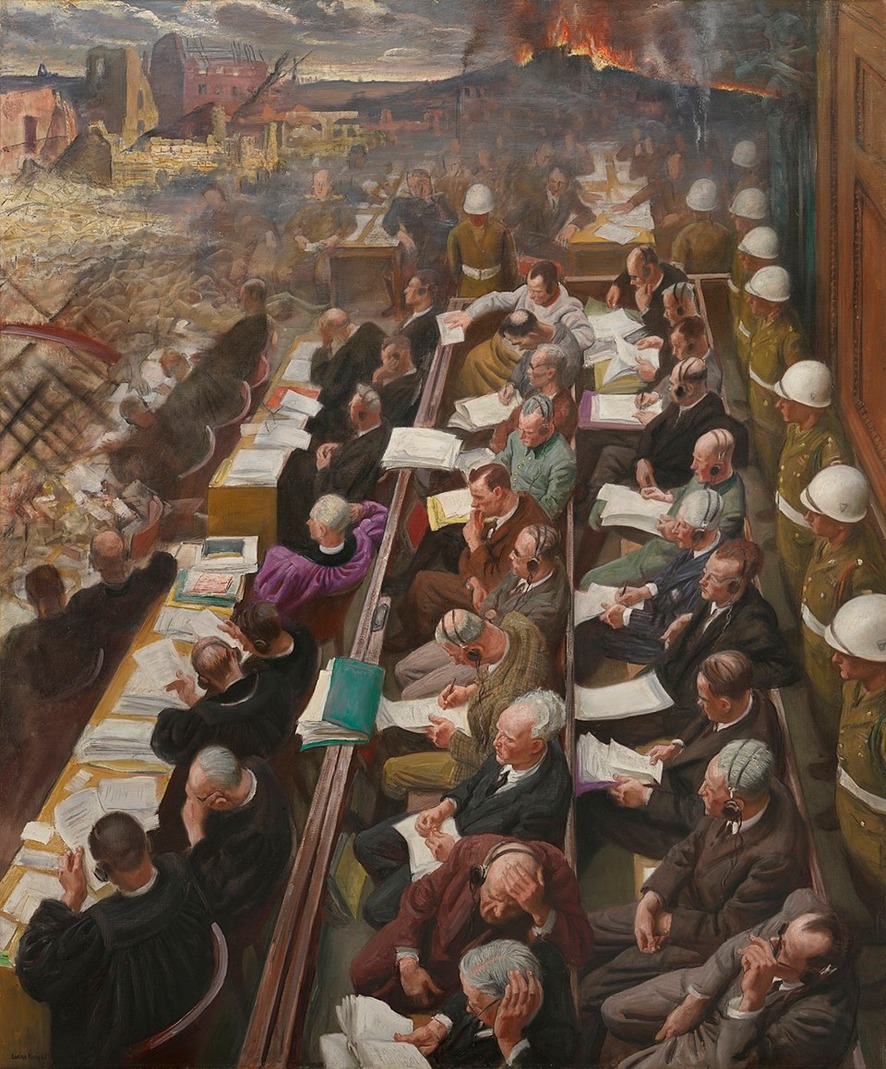
Equally compelling is Knight’s own trajectory. As the first woman elected a full member of the Royal Academy since the eighteenth century, she broke significant barriers in the art world. A powerful counterpoint to the luminous serenity of Marsh Mallows can be found in The Nuremberg Trial, 1946, painted by Laura Knight in the aftermath of World War II. Commissioned after her proposal to document the historic Nuremberg Trials, Knight spent three months in Germany observing the proceedings firsthand. Inside the courtroom, she produced meticulous preparatory drawings in chalk and watercolour, capturing the presence of the Nazi defendants with striking precision. In contrast, in Marsh Mallows, that sense of emancipation is palpable: it is a painting filled with joy, confidence, and the sensual pleasure of paint itself, capturing not just a woman in bloom, but an artist at the height of her expressive power.
- Painting source: https://www.sothebys.com/en/auctions/ecatalogue/2018/european-art-n09869/lot.12.html

Serra Húnter Fellow of Sociology at Universitat Rovira i Virgili.
Former DAAD-Gastprofessorin at Julius-Maximilians-Universität Würzburg