

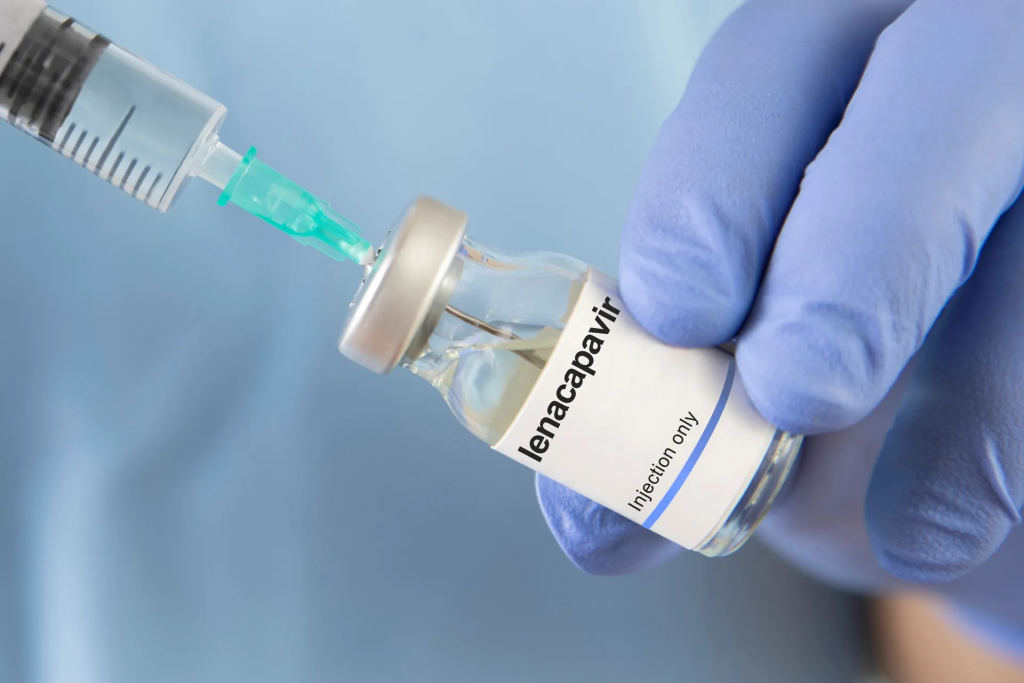
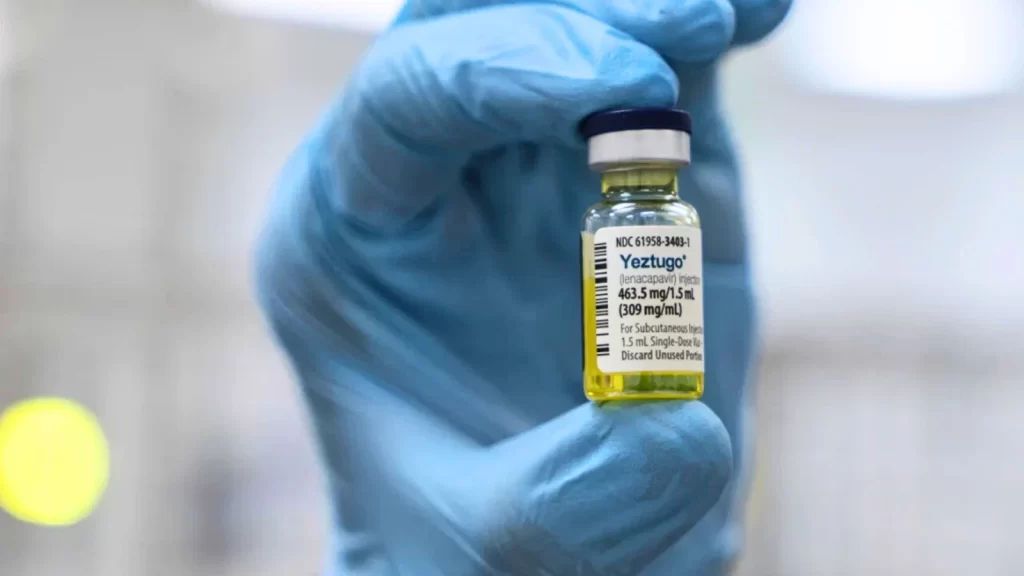
In June 2025, the U.S. Food and Drug Administration (FDA) approved lenacapavir (Yeztugo), the first and only twice-yearly pre-exposure prophylaxis (PrEP) injectable (under the skin) designed to reduce the risk of becoming infected with HIV in eligible adults and adolescents.
Two studies funded by Gilead Sciences, Inc. found twice-yearly lenacapavir to be highly effective in preventing HIV infection. In their study conducted in South Africa and Uganda, zero infections were identified among the 2134 cisgender female participants in the lenacapavir group. Among the 1068 participants in the emtricitabine–tenofovir disoproxil fumarate (F/TDF) active control group, sixteen infections were identified. Their study with 3265 male and gender-diverse participants from trial sites in South Africa, the U.S.A., Peru, Brazil, Thailand, Argentina, and Mexico found two infections over the study period in the lenacapavir group and nine in the F/TDF group.
The twice-yearly injection, described as a “powerful tool” by the Director-General of the World Health Organization, is an extraordinary innovation that offers a superior alternative to the previous forms of PrEP (daily oral pills or bi-monthly injections into muscle).
It provides an opportunity to expand access to HIV prevention for those most at risk and may be especially beneficial for people who face challenges with daily adherence, stigma, or access to care. As of 2022, only 36% of individuals in the U.S.A. who are eligible for PrEP are prescribed it, according to the CDC. Globally, more than 60% of children and adolescents living with HIV live in Eastern and Southern Africa.
Lenacapavir is a drug, but we should think of it as the first highly-effective HIV vaccine, albeit one that needs to be repeated twice a year (like the COVID vaccine). It has the potential to stop the HIV pandemic in its tracks if we can scale it up quickly. In low- and middle-income countries (LMICs) that means accelerating access to the generic drug. This requires accelerating WHO prequalification of the generic products and working, especially in Africa, on agreements that national regulatory authorities will license as soon as WHO prequalification is achieved. The original product from Gilead is already prequalified and every LMIC with high-incidence populations should already be piloting delivery approaches to be ready for the introduction of the low-cost generic. Ministries of health, in partnership with international donors should be husbanding funding to drive rapid scale-up, as this intervention will undoubtedly save money in the long-term when deployed among high-incidence populations.
Targeting high-risk populations such as sex workers, injecting drug users, transgender individuals, people who are incarcerated, men who have sex with men, and young people in high-incidence communities will be essential when initially scaling up lenacapavir delivery to achieve maximum benefit. Stigma and fear are major barriers to PrEP uptake and adherence, leading to a need for decentralized service delivery. Depending on the setting, this may include sexual health clinics, mobile outreach, and pharmacies.
In the high-income countries, scale-up of lenacapavir is akin to a public health emergency for any populations at high risk of becoming infected with HIV. A commitment to large-scale rapid implementation should be a powerful negotiating tool with the supplier to reduce the cost and make rapid scale-up affordable. In the U.S.A., many barriers to use exist, including distribution only through specialist pharmacies, limitations on provider availability, including pharmacists, to prescribe the drug, Kafkaesque reimbursement mechanisms for anyone seeking to provide the service, etc. High-income governments around the world proved that they could rapidly scale-up a life-saving vaccine in record time with COVID. They need to enact similar emergency measures for lenacapavir to achieve rapid scale-up with centralized, standardized funding and reimbursement mechanisms as well as price negotiations.
Awareness of PrEP is also low among those at high risk for HIV infection — in a study in 2025, only half of young adults in the State of Alabama in the U.S.A. knew about PrEP, despite over half of the study population being sexually active. Among female sex workers in the Sex Workers and Police Promoting Health in Risky Environments (SPHRE) cohort in Baltimore, Maryland, 21% were aware of PrEP. In Southern Africa, young women face the highest risk of HIV infection, but PrEP scale-up has yet to reach this high-risk community. There is therefore a significant need for greater effort to promote awareness in high-risk communities.
Lenacapavir can be a monumental leap in HIV prevention if we prioritize improving access for those who most need it. Public agencies, insurers, and health systems need to work toward making twice-yearly PrEP affordable and simple to access and adhere to, especially for those with heightened risk. Lenacapavir offers more than convenience — its extraordinary effectiveness has created the opportunity to stop HIV transmission in entire communities of people still experiencing high HIV incidence.

Master’s in public health student at UC Berkeley, specializing in health policy and management.

Professor at the UC Berkeley School of Public Health. He is participating in implementation studies of lenacapavir funded by the USA NIH, by the State of California, and by Gilead Pharmaceuticals.