

Nitrates are essential for food production: they are mainly generated through the use of fertilisers to increase crop yields. The problem arises when they accumulate in excess and become a silent pollutant. As the global population grows and food demand increases, fertiliser use is likely to intensify in many regions. Part of these nitrates does not remain in the soil: they travel through runoff and leaching, from the ground to aquifers, from aquifers to rivers, and eventually to coastal areas. There, they fuel massive algal blooms — the familiar “pea-soup” green waters — that consume oxygen and disrupt entire ecosystems.
Treating nitrates is not as simple as just “removing” them. Many solutions separate the contaminant (ion exchange membranes and related technologies): they meet regulatory limits in treated water, but transfer the problem to a concentrated brine (a waste stream) rich in salts and nitrates that must then be managed. In real waters, fouling and scaling can also increase maintenance requirements and operating costs. Other alternatives rely on biological denitrification: effective under stable conditions, but dependent on a delicate balance of nutrients, pH, and temperature. When flow, pollutant load or salinity fluctuate, microorganisms can become stressed and lose efficiency, leading to nitrate breakthroughs or the accumulation of by-products such as nitrite. If the process becomes unbalanced, operational issues — including odours — may also arise.
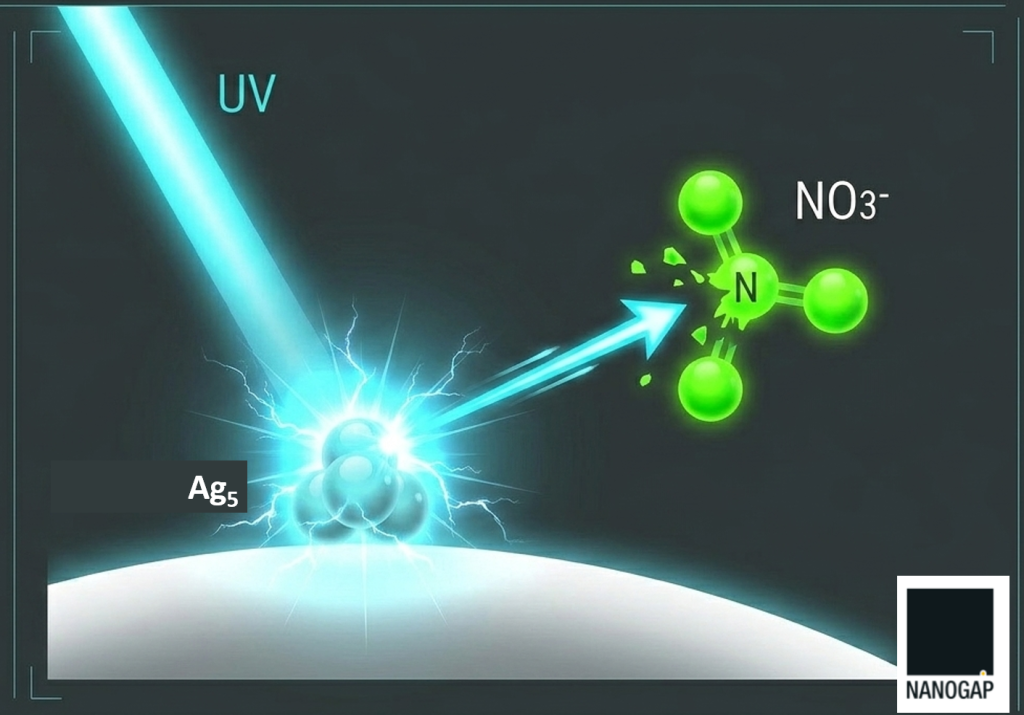
At NANOGAP, we are exploring a different strategy: transforming nitrate through chemistry, guiding the reaction towards products that are more environmentally benign. The ideal target is molecular nitrogen (N₂), which already makes up most of the air we breathe. The key challenge is selectivity: choosing the right reaction pathway whilst avoiding unwanted by-products.
This is where nanotechnology comes into play. At extremely small scales, materials no longer behave as usual. At the boundary between molecules and nanoparticles lie metal molecules, also called atomic quantum clusters: tiny groups of metal atoms containing an exact number of atoms, almost as if each had its own unique “ID”. Size becomes a new dimension: the same element can display very different properties depending on how many atoms compose it — like a “3D periodic table”.
In our case, we use photocatalysis: light provides the energy, but it is the catalyst that opens a lower-energy pathway. Just as a tunnel reduces the effort needed to cross a mountain, a carefully designed material can lower the energy barrier and steer the reaction towards the desired route. The same materials platform is being explored in applications ranging from energy to healthcare, because at the sub-nanometre scale it becomes possible to tune chemistry with remarkable precision.
There are no magic solutions: challenges remain in selectivity, stability, and validation in real-world water matrices. But the concept is powerful — understanding matter atom by atom to design smarter chemistry. Applied to nitrates, this approach could help turn an environmental challenge into cleaner technological solutions.

PhD in Chemical Science and Technology from the University of Santiago de Compostela, specialized in nanochemistry and advanced materials. Her research focuses on atomic quantum clusters (metallic molecules), their synthesis, and catalytic applications with environmental and industrial relevance. She has carried out research stays at international institutions including Technical University of Berlin, University of California, Berkeley, J. Heyrovský Institute of Physical Chemistry, and Brookhaven National Laboratory, and worked with advanced synchrotron techniques at ALBA Synchrotron, Brazilian Synchrotron Light Laboratory (LNLS), and NSLS-II. She is currently Technical Director at NANOGAP S.A..