Freedom of the press has long been a cornerstone of democratic societies, inseparable from the broader principle of freedom of expression. Its modern understanding owes much to movements such as the Free Speech Movement, where students demanded the right to speak, publish, and challenge authority without censorship. This legacy reminds us that press freedom was never meant as an abstract privilege, but as a tool to advance truth, accountability, and social progress.
Yet, this principle has always been contested. In Lost Illusions, Honoré de Balzac exposed a form of journalism driven by scandal and profit rather than truth, foreshadowing many of today’s concerns. Similarly, Émile Zola’s intervention in the Dreyfus Affair through his famous text J’Accuse…! demonstrated both the power of the press to defend justice and its vulnerability to manipulation when guided by vested interests.
These historical reflections are not distant. Today, we repeatedly witness distorted interpretations of press and expression freedoms, where harmful speech is defended under the guise of liberty. But freedom cannot be reduced to individualistic impulses detached from collective responsibility. When discourse legitimizes hate, dehumanizes individuals or groups, or undermines fundamental rights, it ceases to serve democratic values.
Recent scholarly debates also point to new forms of harm in the public sphere. In his latest work, Sari Hanafi reflects on the rise of cancel culture, highlighting how it is sometimes mobilized against individuals in ways that can destroy their personal and professional trajectories. This perspective adds nuance to current discussions, reminding us that the misuse of public discourse, whether through hate speech or punitive forms of exclusion, can erode the very principles that freedom of expression seeks to protect.
Freedom of the press does not mean the freedom to harm. It implies a commitment to truth, to evidence, and to the dignity of all people. Its limits are not a restriction of democracy, but a condition for its survival. A press that tolerates or amplifies hate speech betrays its original purpose.
For this reason, initiatives like Daily27 reaffirm the need for a journalism that serves society rather than narrow interests. Defending press freedom today means reclaiming its foundational principles: rigor, responsibility, and respect for human rights. Only in this way can it continue to be a force for justice and democratic coexistence.
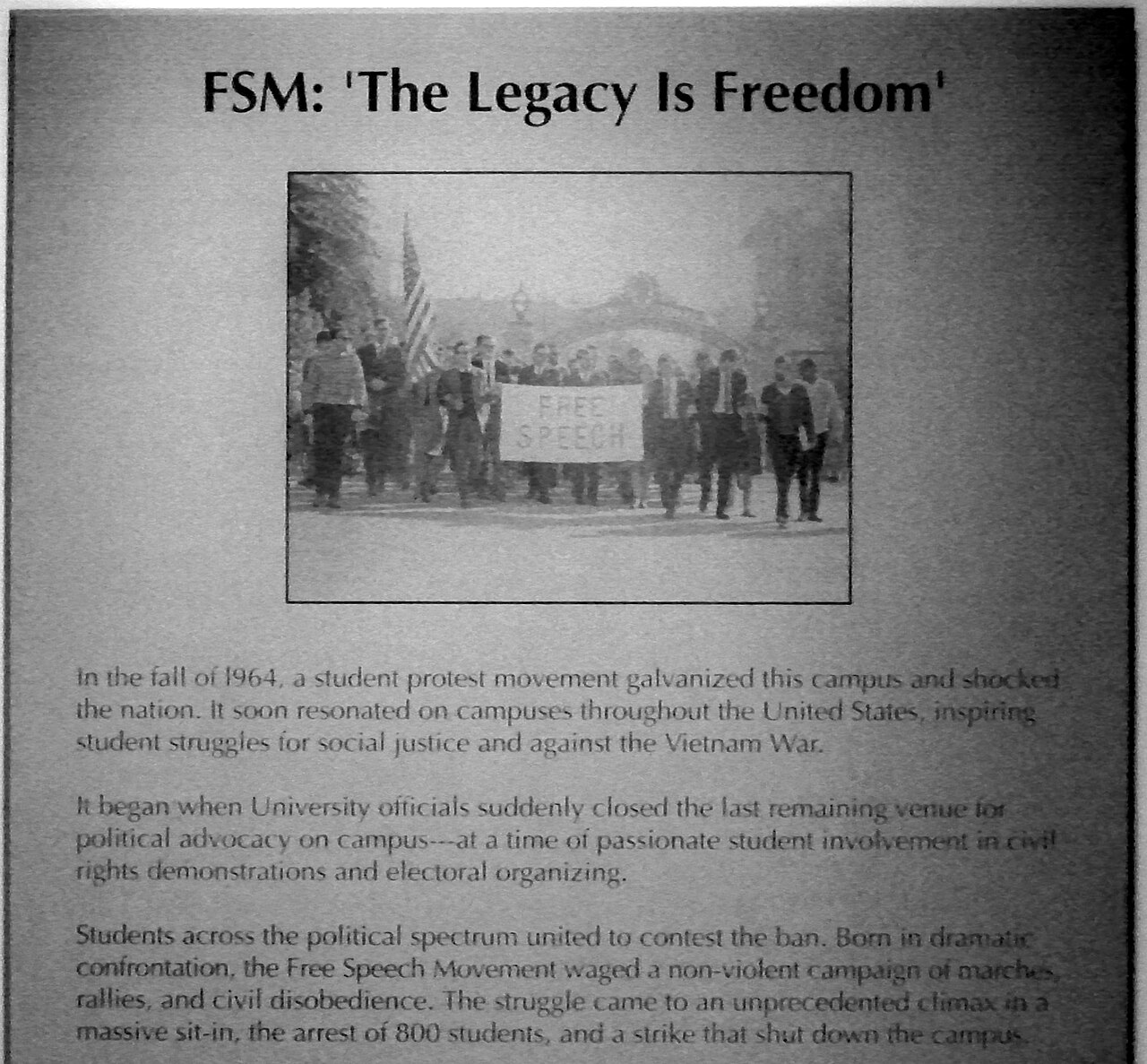 Memorial to the Free Speech Movement at UC Berkeley.
Source: Wikipedia
Memorial to the Free Speech Movement at UC Berkeley.
Source: Wikipedia 
