
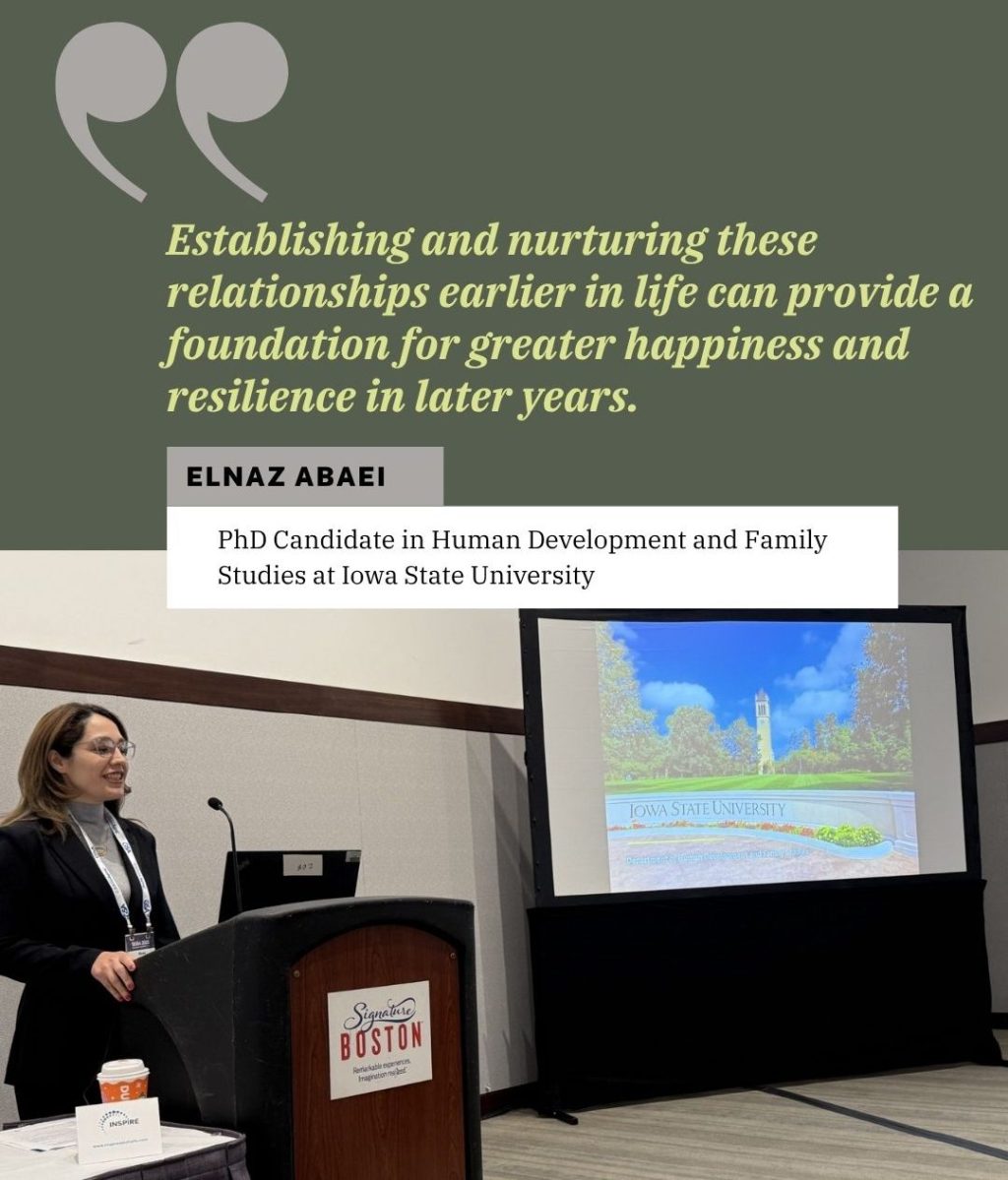
Daily 27 has decided to interview Elnaz Abaei, a PhD candidate in Human Development and Family Studies at Iowa State University. She is, together with Peter Martin, the author of the study “The Association Between Close Relationships and Happiness Among Older Adults,” published in The International Journal of Aging and Human Development, which has already been featured in an informative article in Daily 27. To discuss social relationships, aging, and happiness, it is a pleasure to welcome Elnaz Abaei today.
Elnaz Abaei: Thank you for having me. I’m really happy to talk about my research and share some of what I’ve learned about relationships and happiness in older adults.
Daily 27: What personally motivated you to investigate the relationship between close relationships and happiness in older adults?
EA: When I left my home country to pursue my degree, my parents were 62 and 66 years old, and I observed that they seemed less happy after my transition. This experience made me deeply interested in understanding what contributes to happiness in older adults. I began by studying the role of spouses in emotional well-being, using the Actor–Partner Interdependence Model to examine how older adults and their partners influence each other’s happiness over time. The findings of this longitudinal study are detailed in the abstract [ https://doi.org/10.1093/geroni/igad104.0562 ], and the paper is currently under review by the Journal of Happiness Studies.
Following this, I expanded my research to examine the broader social environment of older adults, including spouses, children, and friends, using longitudinal data. We were particularly interested in how these different relationships interact to influence happiness. Our work revealed that some older adults report feeling generally happy, yet still experience loneliness. This led us to explore additional dimensions of well-being, including loneliness, depression, and cognitive function, recognizing that happiness is a complex and multidimensional construct that extends beyond simple positive affect.
D27: What was the most surprising or counterintuitive finding of your study?
EA: One of the most surprising findings was that happiness alone does not necessarily equate to feeling socially connected. Some older adults reported high levels of life satisfaction, but they still experienced loneliness. This finding challenges the common assumption that happiness and social connectedness are always aligned and emphasizes the need to consider multiple components of well-being when studying older adults. It also highlights the importance of examining both subjective feelings of happiness and relational or social dimensions of well-being in order to understand the full picture of quality of life in later adulthood.
D27: After conducting this research, has your understanding of happiness changed?
EA: Yes, this research has fundamentally shaped my understanding of happiness from a life course and lifespan perspective. It has become clear that the social and emotional resources we cultivate throughout our lives have long-term implications for well-being in older age. Meaningful, emotionally supportive relationships are essential, not only for moment-to-moment happiness but also for resilience and overall life satisfaction. This perspective reinforces that interventions or lifestyle choices aimed at fostering close relationships can have lasting benefits well into older adulthood.
“Activities such as volunteering, participating in community groups, or maintaining consistent communication with loved ones can strengthen social bonds and enhance overall well-being.”
D27: Based on your findings, what advice would you give to someone as they age to enhance their well-being?
EA: One important insight is that well-being is not simply about being surrounded by people, but about cultivating relationships that provide emotional support, mutual understanding, and a sense of purpose. Older adults benefit most from relationships that are meaningful and reciprocal. I would encourage engagement with family, friends, and community in ways that foster emotional closeness. Activities such as volunteering, participating in community groups, or maintaining consistent communication with loved ones can strengthen social bonds and enhance overall well-being. Establishing and nurturing these relationships earlier in life can provide a foundation for greater happiness and resilience in later years.
“By creating environments that support diverse social connections, communities can help older adults maintain higher levels of life satisfaction and psychological resilience, ultimately improving quality of life on a societal scale.”
D27: What is the potential social impact of this research? In what ways could it help improve the quality of life for people in society?
EA: This research has significant implications for social policy and community programs. The loss of a spouse is a common experience in older age and can lead to feelings of loneliness and reduced happiness. Our findings suggest that society and policymakers should provide opportunities for older adults to engage in meaningful social relationships beyond the family, such as through volunteering, social clubs, or community initiatives. Research indicates that such engagement improves well-being, provides a sense of purpose, and reduces social isolation. By creating environments that support diverse social connections, communities can help older adults maintain higher levels of life satisfaction and psychological resilience, ultimately improving quality of life on a societal scale.
