
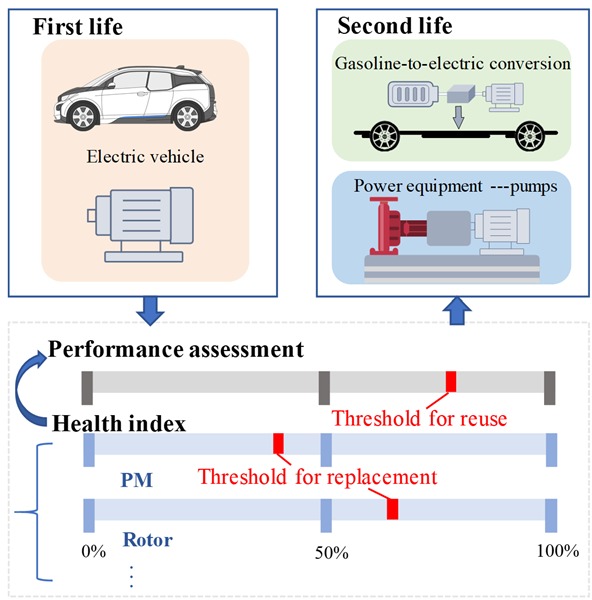
Electric vehicles (EVs) are rapidly transforming global transportation, but with growth comes a hidden challenge: what happens to the motors once their first life on the road ends? Research shows that while batteries often trigger the retirement of EVs, the motors themselves frequently remain in good condition, with plenty of usable life left. Today, most of these motors are simply stripped for metals like copper and rare earths, leaving their true potential untapped.
A recent study proposes a bold shift: instead of dismantling retired EV motors, why not repurpose them directly for industrial and energy applications? With an estimated 500,000 to 1,000,000 EV motors retiring globally every year—a figure set to soar as early models age out—the opportunity is enormous.
The idea is simple but powerful. Many retired EV motors, especially Permanent Magnet Synchronous Motors (PMSMs), retain high efficiency and robust design features. These qualities make them prime candidates for reuse in a wide range of industries. Repurposed motors could power pumps, compressors, and factory equipment, or be adapted into stationary generators for backup power and renewable energy systems. The principle is already proven: regenerative braking in EVs demonstrates how motors can act as generators, so scaling this concept for industrial reuse is entirely feasible.
Beyond economics, the environmental benefits are striking. Reusing whole motors significantly reduces the carbon footprint compared to raw material recovery alone. For instance, repurposing instead of melting down an 80 kW PMSM not only avoids emissions from smelting but also extends the motor’s lifecycle by years, aligning with global goals for circular economy and resource efficiency.
The proposed framework doesn’t ignore challenges. Motors must be evaluated carefully through health indicators like vibration, thermal, and electromagnetic analysis to determine their Remaining Useful Life (RUL). Some motors may be downgraded for lighter applications, while others with mechanical wear can undergo partial remanufacturing. Advanced techniques like AI-driven fault diagnostics and digital twins could streamline this evaluation in the future, making reuse scalable and reliable.
From an economic standpoint, the reuse approach often outperforms simple material recycling. While the resale value of recovered rare earth magnets may reach a few hundred dollars, keeping the motor intact for reuse in industrial machinery can deliver far greater returns. Moreover, industries are eager for mid-range motors in the 50–150 kW power bracket—the exact range where most EV traction motors fall.
The message is clear: as EV adoption accelerates, so too does the responsibility to manage their end-of-life sustainably. By shifting focus from raw materials to whole-motor reuse, we unlock new value streams, reduce waste, and take a crucial step toward greener industry.
The motor that once powered your car may one day run a factory pump, drive a wind turbine, or keep the lights on during a blackout. In this vision of sustainable technology, retirement doesn’t mean the end—it means a second life.

Reader (Associate Professor) at King’s College London; he is the Fellow of IET and member of UK Young Academy. He was the group head of electrical engineering at the University of York and was awarded the Royal Society Industry Fellowship and EPSRC Power Electronics Centre Impact Acceleration Fellowship in 2020 and 2017 respectively. He has published 200 journal papers in IEEE Transactions journals (top journals in electrical engineering) and one paper in prestigious Nature journal with over 14000 citations and h-index of 65. He is the author of 15 patents and serves as an Associate Editor of IEEE Trans. on Industrial Electronics, Scientific Reports and IET RPG. His research interests include renewable generation, electric vehicles, smart energy conversion systems and non-destructive test technology. His research output was a finalist for the Technology transfer category of the IET Innovation Awards 2019. He and his student span out two companies (青岛观芯科技有限公司 and Yorkshire Electronics & Education .Ltd) and attracted ¥10million venture capital investment. His supervised PhD students were awarded IET Postgraduate Award 2021 and STEM for Britain 2022 award. His research was translated into commercial innovation through DX Energy, culminating in the Home Energy Router, which received the prestigious Gold Medal at the 50th Geneva International Exhibition of Inventions.