
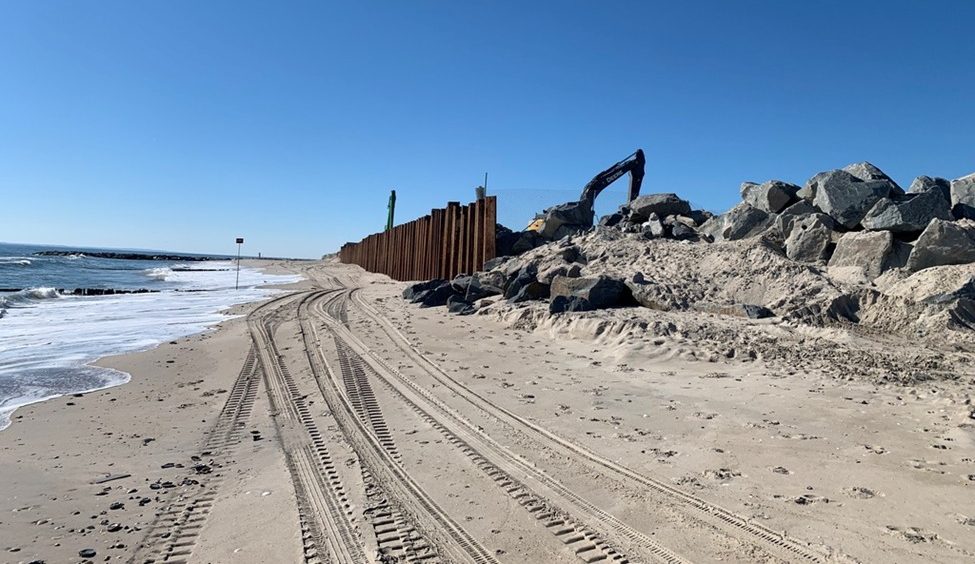
Global climate change is forcing coastal cities to confront a socio-environmental paradox. On the one hand, a growing share of the human population is living near the sea. On the other hand, coastal locations are increasingly vulnerable to flooding due to sea level rise and intensified storms. The result of this paradox is increasing coastal precarity for populations and assets. A common response to coastal climate disasters in the 21st century around the world – in cities including New York, Jakarta, and Lagos – has been proposals to build big, expensive walls around cities to hold back the sea.
Governments provide the leading and largest responses to climate-change-related urban coastal disasters. They decide whether to reinvest and rebuild, to what degree, and in what ways. Public investment in urban coastal climate resilience following disasters shapes long-term development paths and social equity in cities. Governments use four basic strategies: a ‘do nothing’ approach (leaving markets to decide), managed retreat (moving people and assets away from the coast), accommodation with limited structural mitigation (floodproofing and raising buildings and infrastructure above the flood line), and massive coastal reconstruction (armoring the shoreline to hold back the sea).
Some climate disaster responses can lead to ‘perverse adaptation’ by increasing population densities on climate vulnerable coasts. While managed retreat is most effective at protecting people in the long run, it is unpopular with governments looking to expand tax bases, developers looking to expand investment opportunities, and people attached to place and community. Massive coastal reconstruction to armor shorelines encourages both populations and investments to expand along precarious coasts, as residents and investors feel more secure. The resulting increased coastal density commits the state to further investments over time, requiring larger shares of public resources. The more people and assets that are located along precarious coasts, the more politically and economically unworkable managed retreat becomes. As seas continue to rise, coastal barriers require constant reinvestment to remain effective (as such barriers have a limited lifespan and are built to specific parameters based on sea level rise projections). The combination of the sunk costs in coastal development and the levee effect, which encourages further investment, makes more ecologically and economically rational responses to urban coastal resilience decreasingly acceptable. To avoid a downward spiral of perverse adaptation on the coasts, public policy makers must overcome short-term political and economic interests to promote understanding of the ecological consequences of an economy based on burning fossil fuels. One of those consequences is that the sea will submerge our coasts, and we will have to move back or be sunk.

Professor of Sociology and Urban Sustainability at the City University of New York-Brooklyn College, and Professor of Sociology and Earth and Environmental Sciences at the CUNY Graduate Center. His work centers on the political economy of environment, technology and development contributing to theoretical frameworks including the Treadmill of Production and Green Gentrification. His recent research examines implications of urban greening and climate resilience for inequality, relationships between ecotourism and extraction, and the impacts of climate change on efforts to achieve sustainable development trajectories.

Professor of environmental sociology at the City University of New York (Brooklyn College and CUNY Graduate Center). Her research examines urban sustainability and alternatives to development. Her books include Green Gentrification: Urban Sustainability and the Struggle for Environmental Justice (Routledge, co-authored with Kenneth A. Gould), Ecuador’s Environmental Revolutions: Ecoimperialists, Ecodependents, and Ecoresisters (MIT Press), and Twenty Lessons in Environmental Sociology, 4th edition (Oxford University Press, co-edited with Gould).