

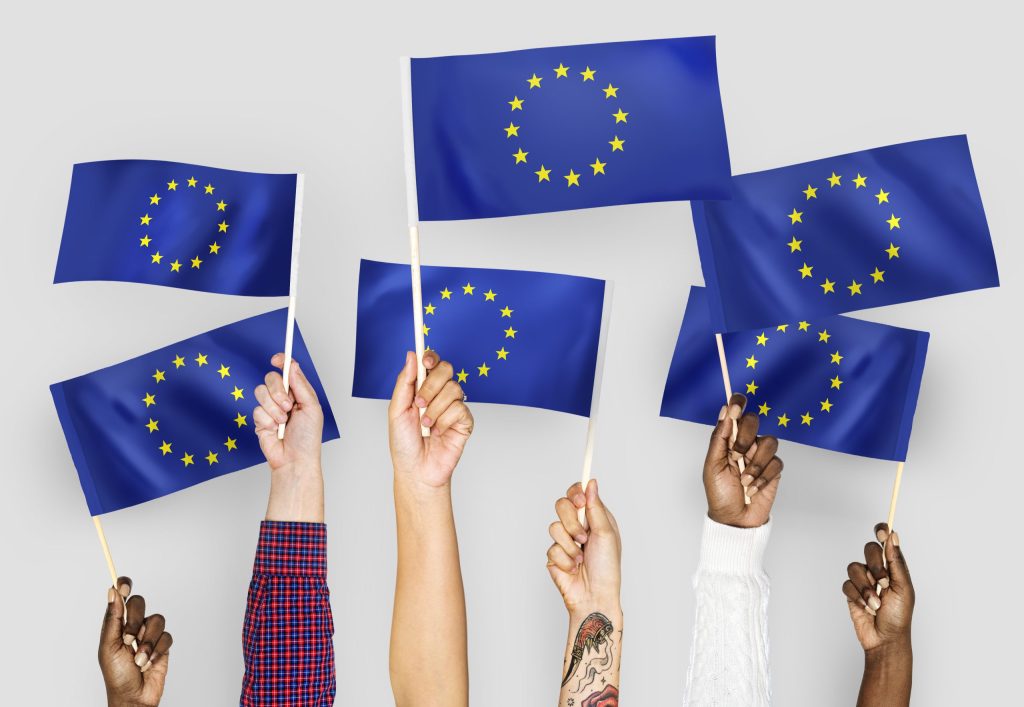
The word “Europe” is Greek, yet the awareness of belonging to a distinct cultural community took centuries to crystallize. An early embryo of this idea can be traced back to the Carolingian Empire: around the year 800, Charlemagne’s realm united under Latin Christianity the territories that today correspond to France, Germany, and Italy. Medieval Christendom functioned as a shared identity, though without its own political vocabulary. It was the colonial expansion of the 15th and 16th centuries that forced Europeans to define themselves in contrast to the rest of the world, while the Enlightenment of the 18th century transformed that self-awareness into an explicit project of values: reason, liberty, and progress. Yet the idea of Europe as a concrete institutional project only emerged in the 20th century, after the catastrophe of two world wars.
That birth has an exact date and a coincidence laden with symbolism. On May 9, 1950, Robert Schuman proposed placing the coal and steel production of France and Germany under a common authority, making another war materially impossible. It was no accident that Schuman chose that date: May 9 was already the day on which Russia and the countries of Eastern Europe commemorated victory over Nazi Germany, whose surrender was signed on the night of May 8, 1945, when it was already May 9 in Moscow. Thus, the Schuman Declaration was symbolically founded upon the anniversary of the defeat of totalitarianism, turning May 9 into a double commemoration: the shared victory against Nazism and the beginning of European integration. Since 1985, the European Union has officially celebrated Europe Day on that date. This year, 2026, also marks the 40th anniversary of the accession of Spain and Portugal.
Is Russia part of Europe? Its position in relation to Europe has always been liminal. Geographically, 77% of its territory lies in Asia, yet most of its population lives in the European part of the country. Culturally, its great figures — Pushkin, Tolstoy, Dostoevsky, Tchaikovsky, Kandinsky — are inseparable from the European tradition. Since the time of Peter the Great, Russia has oscillated between a European vocation and the assertion of a distinct Slavic identity, a debate embodied in the 19th century by the Westernizers and the Slavophiles. The Mongol invasions, the Orthodox tradition, and centuries of political separation distanced Russia from processes such as the Renaissance and the Reformation. Yet the victory of 1945 demonstrated something undeniable: when Europe confronted Nazi totalitarianism, Russians and Western Europeans fought on the same side. The Soviet Union’s 27 million war dead represent the greatest sacrifice made by any single country in defense of values that we now regard as European: human dignity and the rejection of barbarism.
Precisely for that reason, the spirit of May 9 — both that of 1945 and that of 1950 — invites us to think in terms of a shared logic: unity against totalitarianism and in favor of democracy, enlightenment, and progress. On the cultural level, the common heritage of literature, music, and science provides fertile ground for dialogue. Economically, the complementarity between Russian natural resources and European technological capacity could generate mutual prosperity. And in terms of security, a space of trust stretching from Lisbon to the Urals — the old aspiration of leaders such as Mitterrand and Gorbachev — would make the continent a more stable global actor. The Schuman Declaration itself teaches that the most enduring peace is built by intertwining interests so deeply that conflict becomes unthinkable. Applying that logic to relations with Russia, while recovering the memory of a victory that belonged to all, remains one of the great unfinished challenges of the European idea.

Associate professor of Sociology at the University of Girona