

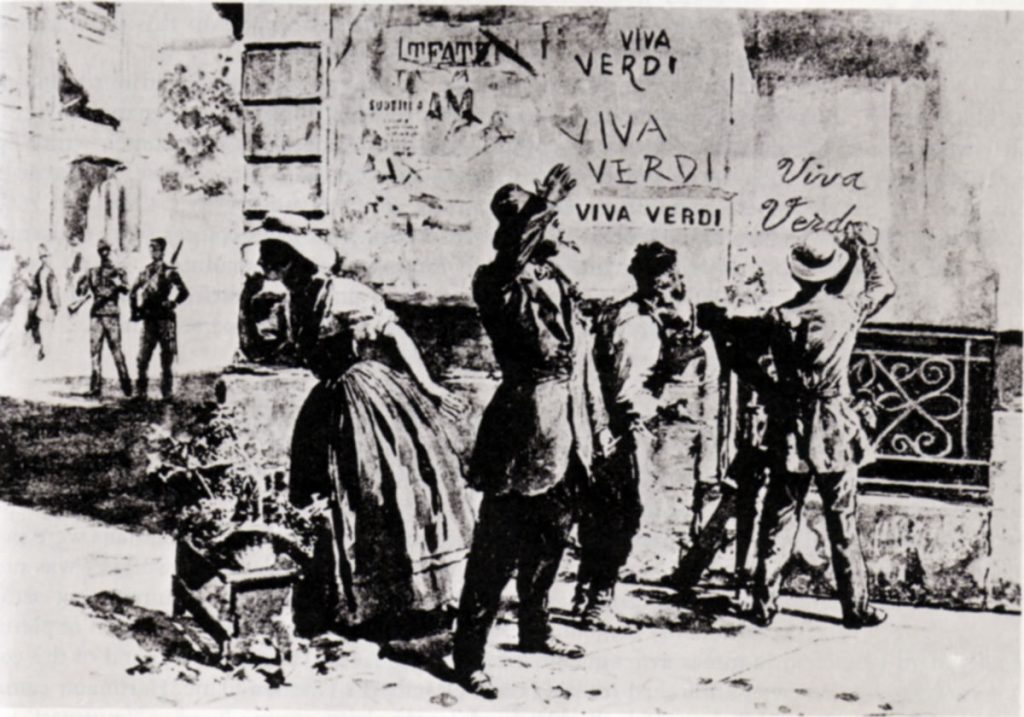
“Viva V.E.R.D.I.” was far more than a tribute to a beloved composer. During the Risorgimento, the long struggle for Italian unification in the 19th century, the phrase became a coded political message. Written on walls and whispered in theatres, the acronym stood for “Viva Vittorio Emanuele Re D’Italia” (“Long live Victor Emmanuel, King of Italy”). At a time when censorship was strict and Austria controlled much of northern Italy, these initials allowed patriots to express a revolutionary idea: that Italy should finally become a unified and independent nation.
Giuseppe Verdi’s music provided the emotional soundtrack of that aspiration. Operas such as Nabucco (1842), especially the chorus Va, pensiero, evoked themes of exile, the longing for freedom, and the dignity of oppressed peoples. Audiences immediately associated the lament of the Hebrew slaves with their own situation under Austrian rule. Similar patriotic energy flowed through works like I Lombardi, La battaglia di Legnano, and later the powerful choral cries of Patria oppressa in Macbeth. Though not always explicitly political, Verdi’s operas became deeply symbolic for a public hungry for national identity.
Meanwhile, Italian patriots, including Mazzini, the carbonari, Garibaldi, and the diplomatic strategist Cavour, were fighting on political, military, and ideological fronts. Uprisings such as the Five Days of Milan (1848) intensified the climate, and the theatre became a space where national sentiment was shared collectively. Verdi himself often battled censorship, as shown when Un ballo in maschera had to be altered following an assassination attempt on Napoleon III.
Although Verdi reluctantly accepted a brief appointment as senator, he preferred to express political ideas through art. His work articulated the tensions of power (Don Carlo), the struggle for liberation (I vespri siciliani), and the moral weight of sacrifice (La battaglia di Legnano). For Italians of the time, “Viva V.E.R.D.I.” captured this fusion of culture, patriotism, and hope. Through music, symbol, and coded resistance, the slogan became a rallying cry for the birth of a nation, and remains a reminder of how culture can shape history.

Serra Húnter Fellow of Sociology at Universitat Rovira i Virgili.
Former DAAD-Gastprofessorin at Julius-Maximilians-Universität Würzburg