


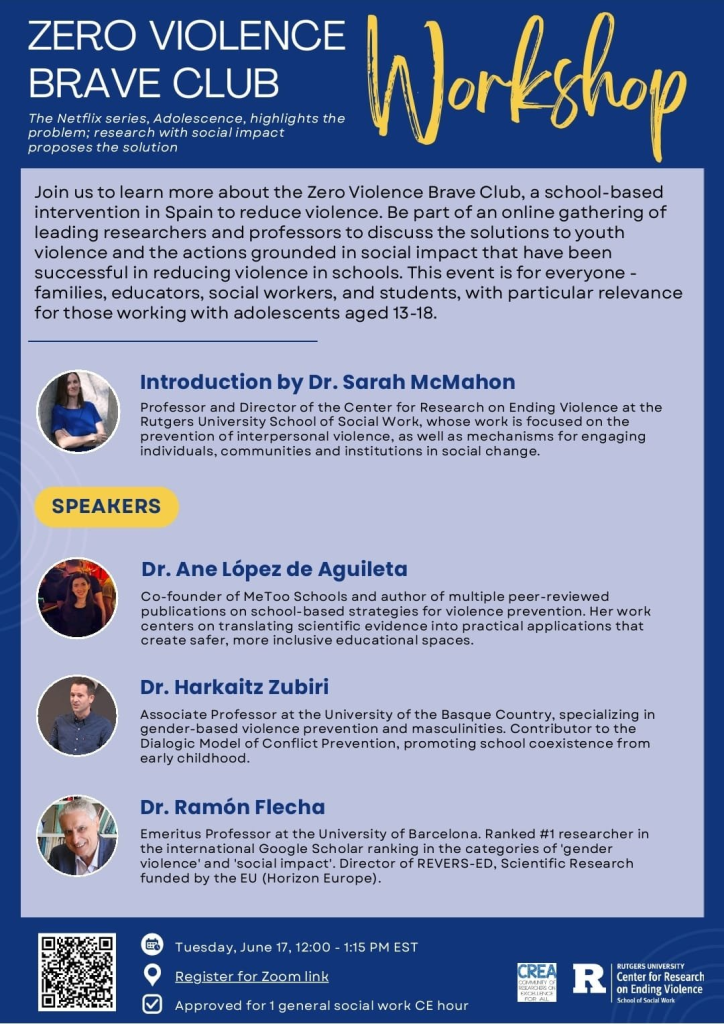
On 17 June, the Center for Research on Ending Violence (Rutgers University) and CREA (Community of Researchers on Excellence for All) organized the Zero Violence Brave Club Workshop with more than 120 attendees. The debate centered on Scientific Evidence of Social Impact (ECIS by its Spanish initials) as a key element in making Bystander Intervention a reality across all shared spaces—whether family, school, workplace, or leisure environments.
The event was attended by the academics who are achieving the greatest social impact in violence prevention in different contexts, including more than 15,000 primary and secondary schools, as well as global sports organisations such as FIFA.
Ane López de Aguileta, founder of the MeToo Schools movement spoke about how harmful the coercive discourse that currently dominates our society is for the victims, and which particularly affects children and adolescents. In countries such as Spain, public funds financed for decades teacher training programmes based on hoaxes – such as ‘to be in love is coercion and have sex with anyone, especially with boys with violent attitudes, is freedom’. This hurts victims and make them even more ill. But it also explains that the fear of reprisals is the main reason for the silence maintained by victims instead of telling someone.
The solution exists: the Zero Violence Brave Club. Created and implemented in thousands of communities worldwide, spanning diverse cultural and socioeconomic contexts, it is being led by a very different people. Teachers, families, children and young people, neighbours and volunteers contribute every day to the co-creation process in their immediate environments in accordance with the knowledge provided by ECIS.
Harkaitz Zubiri, Principal Investigator of the research group BIZI in the University of the Basque Country (UPV-EHU), shared inspiring examples of courageous children and youth who actively stand against violence by defending victims—always non-violently and in all settings. Meanwhile teachers encourage and protect those who protect victims. ‘You can start something big with five students. It’s fine!’ – he said.
Professor Ramon Flecha, who created the concept of Social Impact and ranks first worldwide on Google Scholar, presented the five key ECIS everyone should know to make Bystander Intervention a reality:
1. The difference between the language of desire and the language of ethics
2. The double standard that reproduces disdain and violence towards some girls and boys
3. The predatory capital that is at the origin of the promotion of disdainful hook-ups and the normalization of violence in affective and sexual relationships.
These ECIS demonstrate that violence is not something natural but has been imposed on us from outside.
Everything can change if we know that the goal of any abuser is to isolate the victims so they can keep abusing them. That’s why they use Isolating Gender Violence attacking friends and anyone who stands up for the victim.
4. Those who decide to protect a victim have the best weapon: explaining the real reason behind any attack or defamation they may receive.
5. Having one good friend, who starts taking a stand against violence becomes the necessary first step to ensure that the vast majority become upstanders.
Making Bystander Intervention a reality is the best way to prevent violence.

Former Dean of the Faculty of Political Sciences and Sociology at the Universitat Autònoma de Barcelona; she is currently a Visiting Academic at the School of Social and Political Science at the University of Edinburgh.