

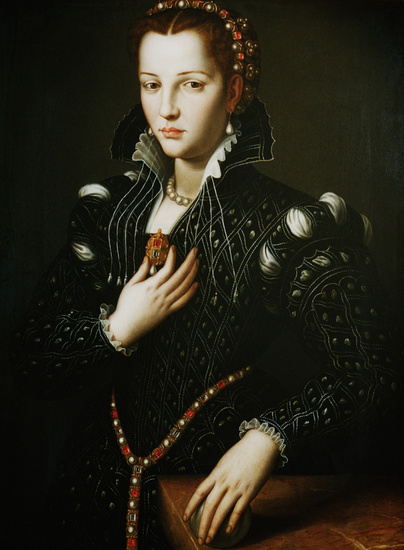
The Medici family is often remembered as one of the great patrons of art and culture in Renaissance Europe. Their support of artists such as Michelangelo, Botticelli, and Leonardo da Vinci has shaped the way history portrays them: enlightened rulers who fostered creativity, beauty, and humanist thought. Yet this celebrated image tells only part of the story. Behind the splendour of palaces and masterpieces lies a far more complex, and darker, reality, particularly when we examine the lives of women within the Medici orbit.
Lucrezia de’ Medici, married at a young age to Alfonso II d’Este, died at just sixteen. Officially, her death was attributed to illness, but persistent contemporary rumours suggested poisoning, revealing how little protection even the most powerful women enjoyed within political marriages. Her sister Isabella de’ Medici, intelligent and outspoken, met an even more explicit fate. In 1576, she was murdered on the orders of her husband, Paolo Giordano Orsini, with the tacit approval of her brother, the Grand Duke of Tuscany. Her alleged independence and rumoured affairs were framed as threats to male honour, providing justification for her killing.
That same year, Eleonora di Garzia di Toledo, Isabella’s sister-in-law and wife of Pietro de’ Medici, was also killed, likely stabbed by her husband. Once again, accusations of infidelity served to excuse lethal violence. No meaningful consequences followed for the men involved. Power, lineage, and reputation mattered more than women’s lives.
These stories challenge the simplified narrative of the Medici as benevolent art protectors. They remind us that cultural patronage coexisted with brutal systems of control, especially over women. History often highlights the family’s contributions to art while silencing the violence embedded in their private and political lives. Revisiting the deaths of Lucrezia, Isabella, and Eleonora forces us to confront a broader truth: greatness in art does not absolve cruelty, and understanding the past requires looking beyond what power chose to preserve.

Serra Húnter Fellow of Sociology at Universitat Rovira i Virgili.
Former DAAD-Gastprofessorin at Julius-Maximilians-Universität Würzburg